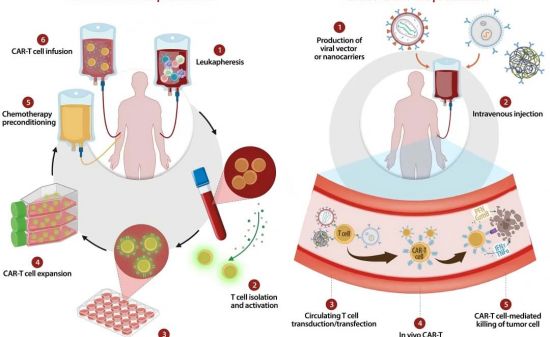
Currently, all 12 CAR-T cell therapies approved in global and Chinese markets are based on the ex vivo CAR-T approach. This type of therapy involves isolating autologous T cells from the patient's body, genetically engineering and expanding them in vitro, and then reinfusing them back into the patient to exert anti-tumor effects. While ex vivo CAR-T therapies have demonstrated remarkable clinical efficacy in oncology, their complex manufacturing processes, long production timelines, and high costs significantly limit large-scale commercialization and patient accessibility.
In the clinical application of ex vivo CAR-T therapy, lentiviral vectors have become the core vehicle for gene delivery due to mature technology and extensive clinical experience. Based on this advantage, lentiviral vectors have naturally become the delivery tool of choice for in vivo CAR-T therapy, laying the foundation for breaking through clinical application bottlenecks and expanding treatment coverage, bringing new hope to more cancer patients.
Compared with traditional ex vivo CAR-T cell therapy, lentivirus in vivo CAR-T cell therapy has achieved significant breakthroughs in production efficiency, safety, and treatment compatibility.
Simplified Process, Reduced Costs and Time
In vivo CAR-T therapy eliminates the complex steps of in vitro cell culture and genetic modification, directly injecting lentiviral vectors into the patient's body, greatly simplifying the production process. This not only reduces production costs but also shortens the treatment cycle, allowing patients to receive treatment more quickly.
Increased Safety, Avoiding In Vitro Risks
In vivo CAR-T therapy avoids the potential risks of cell contamination and variation during in vitro production, improving the safety of the treatment.
No Lymphodepletion Required, Preserving Immune Function
Patients do not need to undergo chemotherapy regimens for lymphodepletion, maintaining an intact immune system. The high titer and high infection efficiency of lentiviral vectors also ensure that sufficient T cells complete genetic modification in the body, thereby exerting a powerful anti-tumor effect.


Driven by these advantages, increasing numbers of researchers and biotech companies are advancing the development of lentiviral in vivo CAR-T therapies. The year 2024 marks a significant milestone, with two lentiviral-based in vivo CAR-T programs receiving regulatory approval to enter Phase I clinical trials.
Interius's core pipeline INT2104 is a non-replicating, self-activating lentivirus in vivo CAR vector. On July 9, 2024, the project was approved by the Australian Therapeutic Goods Administration (TGA) to conduct Phase I clinical trials for the treatment of B-cell malignancies.
A key innovation of INT2104 lies in its dual-targeted transduction capability. By incorporating a CD7-targeting antibody fragment into the vector, it enables transduction of both T cells and NK cells in vivo. These engineered cells express CAR constructs targeting CD20, enabling coordinated CAR-T and CAR-NK activity to efficiently eliminate CD20-positive tumor cells.
Umoja has developed UB-VV111, a CD19-targeted in vivo CAR-T therapy based on its proprietary VivoVec platform, which received IND clearance from the U.S. FDA on August 1, 2024. The VivoVec platform features two major innovations:
1. Enhanced T cell activation and transduction through co-expression of CD3-binding domains with co-stimulatory molecules CD58 and CD80;
2. Improved targeting specificity via the use of Cocal glycoprotein as the viral envelope, which binds to LDL receptors on host cells to direct precise delivery to T cells.
The engineered nanobody lentivirus (ENaBL) platform at EsoBiotec is an innovative in vivo cell therapy technology platform. It utilizes highly targeted lentiviral vectors as carriers to directly transduce genetic information to T cells in vivo, enabling them to recognize and destroy tumor cells or modulate autoreactive immune cells.ESO-T01 is an in vivo CAR therapy targeting multiple myeloma. EsoBiotec uses third-generation lentiviral vector technology, combining nanobodies fixed on the viral envelope surface to provide the ability to target specific cells, while introducing CD47 molecule expression, reducing the probability of vector phagocytosis and off-target transduction effects. ESO-T01 has entered clinical trials and demonstrated promising preliminary efficacy.
Kelonia's core lentiviral vector in vivo gene delivery platform (iGPS®) can efficiently and precisely deliver CAR genes to target cells, generating CAR-T cells in vivo for treating cancer and other diseases. Its representative pipeline KLN-1010 is an in vivo CAR therapy targeting multiple myeloma, currently in clinical development. The iGPS® platform focuses on "efficient transduction" and "precise targeting," ensuring that the CAR gene is expressed only in target T cells through vector structure optimization, reducing impacts on normal cells, and further enhancing the safety and efficacy of the treatment.
Despite its promising potential, in vivo CAR-T therapy presents higher requirements for manufacturing, safety testing, and release standards, as a lentivirus product directly injected into the body. Among these, replication-competent lentivirus (RCL) detection is a critical component of biosafety evaluation.
Currently, RCL detection for lentivirus in vivo CAR-T therapy still faces many challenges:
Unlike traditional VSV-G enveloped lentiviral vectors, the envelope design of lentivirus in vivo CAR vectors varies among different customers, posing challenges to the selection of susceptible cells for the virus.
According to the CDE "Common Issues and Technical Requirements for Detecting Replicative Lentivirus," it is recommended to use at least 5% of untreated viral vector supernatant for RCL detection, making the volume of the end product to be tested too large, imposing higher demands on detection capability and methods.
Selection of the positive control virus and ensuring the stability of the positive control virus library.
Establishment of high-sensitivity endpoint detection methods.
BRC Biotech leverages extensive project experience and well-established RCL detection methodologies compliant with Chinese, U.S., and European pharmacopeia standards to develop customized co-culture systems and RCL testing strategies tailored to the specific envelope designs of in vivo CAR lentiviral vectors.
The company provides testing solutions under Biosafety Level 3 (BSL-3) conditions, incorporating wild-type HIV-1 as a positive control. In addition, BRC Biotech has independently developed and validated multiple high-sensitivity endpoint detection methods, including qPCR, p24 assays, and QPERT. All processes are managed within a GMP-compliant framework, ensuring robust risk control for lentiviral vector production.